
Television
 American family watching TV, 1958 |
Television became available in crude experimental forms in the late 1920s, but it would still be several years before the new technology would be marketed to consumers. After World War II, an improved form of black-and-white TV broadcasting became popular in the United Kingdom and United States, and television sets became commonplace in homes, businesses, and institutions. During the 1950s, television was the primary medium for influencing public opinion. In the mid-1960s, color broadcasting was introduced in the US and most other developed countries. The availability of multiple types of archival storage media such as Betamax and VHS tapes, high-capacity hard disk drives, DVDs, flash drives, high-definition Blu-ray Discs, and cloud digital video recorders has enabled viewers to watch pre-recorded material—such as movies—at home on their own time schedule. For many reasons, especially the convenience of remote retrieval, the storage of television and video programming now also occurs on the cloud (such as the video on demand service by Netflix). At the end of the first decade of the 2000s, digital television transmissions greatly increased in popularity. Another development was the move from standard-definition television (SDTV) (576i, with 576 interlaced lines of resolution and 480i) to high-definition television (HDTV), which provides a resolution that is substantially higher. HDTV may be transmitted in various formats: 1080p, 1080i and 720p. Since 2010, with the invention of smart television, Internet television has increased the availability of television programs and movies via the Internet through streaming video services such as Netflix, Amazon Video, iPlayer and Hulu.
 |
In 2013, 79% of the world's households owned a television set. The replacement of early bulky, high-voltage cathode ray tube (CRT) screen displays with compact, energy-efficient, flat-panel alternative technologies such as LCDs (both fluorescent-backlit and LED), OLED displays, and plasma displays was a hardware revolution that began with computer monitors in the late 1990s. Most TV sets sold in the 2000s were flat-panel, mainly LEDs. Major manufacturers announced the discontinuation of CRT, DLP, plasma, and even fluorescent-backlit LCDs by the mid-2010s. In the near future, LEDs are expected to be gradually replaced by OLEDs. Also, major manufacturers have announced that they will increasingly produce smart TVs in the mid-2010s. Smart TVs with integrated Internet and Web 2.0 functions became the dominant form of television by the late 2010s.
Television signals were initially distributed only as terrestrial television using high-powered radio-frequency television transmitters to broadcast the signal to individual television receivers. Alternatively television signals are distributed by coaxial cable or optical fiber, satellite systems and, since the 2000s via the Internet. Until the early 2000s, these were transmitted as analog signals, but a transition to digital television was expected to be completed worldwide by the late 2010s. A standard television set is composed of multiple internal electronic circuits, including a tuner for receiving and decoding broadcast signals. A visual display device which lacks a tuner is correctly called a video monitor rather than a television.
Contents
· 1: History
- 1.1: Color TV
· 2: Geographical usage
· 3: Content
- 3.1: Programming
- 3.2: Funding
- 3.2.1: Advertising
- 3.2.1.1: United States
- 3.2.1.2: United Kingdom
- 3.2.1.3: Ireland
- 3.2.2: Taxation or license
- 3.2.3: Subscription
- 3.3: Genres
· 4: Sales of television sets
· 5: Social aspects and effects on children
· 6: Environmental aspects
History
In its early stages of development, television employed a combination of optical, mechanical and electronic technologies to capture, transmit and display a visual image. By the late 1920s, however, those employing only optical and electronic technologies were being explored. All modern television systems relied on the latter, although the knowledge gained from the work on electromechanical systems was crucial in the development of fully electronic television.
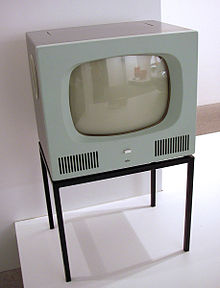 Braun HF 1 television receiver, Germany, 1958 |
The first images transmitted electrically were sent by early mechanical fax machines, including the pantelegraph, developed in the late nineteenth century. The concept of electrically powered transmission of television images in motion was first sketched in 1878 as the telephonoscope, shortly after the invention of the telephone. At the time, it was imagined by early science fiction authors, that someday that light could be transmitted over copper wires, as sounds were.
The idea of using scanning to transmit images was put to actual practical use in 1881 in the pantelegraph, through the use of a pendulum-based scanning mechanism. From this period forward, scanning in one form or another has been used in nearly every image transmission technology to date, including television. This is the concept of "rasterization", the process of converting a visual image into a stream of electrical pulses.
In 1884, Paul Gottlieb Nipkow, a 23-year-old university student in Germany, patented the first electromechanical television system which employed a scanning disk, a spinning disk with a series of holes spiraling toward the center, for rasterization. The holes were spaced at equal angular intervals such that, in a single rotation, the disk would allow light to pass through each hole and onto a light-sensitive selenium sensor which produced the electrical pulses. As an image was focused on the rotating disk, each hole captured a horizontal "slice" of the whole image.
Nipkow's design would not be practical until advances in amplifier tube technology became available. Later designs would use a rotating mirror-drum scanner to capture the image and a cathode ray tube (CRT) as a display device, but moving images were still not possible, due to the poor sensitivity of the selenium sensors. In 1907, Russian scientist Boris Rosing became the first inventor to use a CRT in the receiver of an experimental television system. He used mirror-drum scanning to transmit simple geometric shapes to the CRT.
 Vladimir Zworykin demonstrates electronic television (1929). |
Using a Nipkow disk, Scottish inventor John Logie Baird succeeded in demonstrating the transmission of moving silhouette images in London in 1925, and of moving, monochromatic images in 1926. Baird's scanning disk produced an image of 30 lines resolution, just enough to discern a human face, from a double spiral of Photographic lenses. This demonstration by Baird is generally agreed to be the world's first true demonstration of television, albeit a mechanical form of television no longer in use. Remarkably, in 1927, Baird also invented the world's first video recording system, "Phonovision": by modulating the output signal of his TV camera down to the audio range, he was able to capture the signal on a 10-inch wax audio disc using conventional audio recording technology. A handful of Baird's 'Phonovision' recordings survive and these were finally decoded and rendered into viewable images in the 1990s using modern digital signal-processing technology.
In 1926, Hungarian engineer Kálmán Tihanyi designed a television system utilizing fully electronic scanning and display elements, and employing the principle of "charge storage" within the scanning (or "camera") tube.
On 25 December 1926, Kenjiro Takayanagi demonstrated a television system with a 40-line resolution that employed a CRT display at Hamamatsu Industrial High School in Japan. This was the first working example of a fully electronic television receiver. Takayanagi did not apply for a patent.
By 1927, Russian inventor Léon Theremin developed a mirror-drum-based television system which used interlacing to achieve an image resolution of 100 lines.
 Philo Farnsworth |
In 1927, Philo Farnsworth made the world's first working television system with electronic scanning of both the pickup and display devices, which he first demonstrated to the press on 1 September 1928.
WRGB claims to be the world's oldest television station, tracing its roots to an experimental station founded on 13 January 1928, broadcasting from the General Electric factory in Schenectady, NY, under the call letters W2XB. It was popularly known as "WGY Television" after its sister radio station. Later in 1928, General Electric started a second facility, this one in New York City, which had the call letters W2XBS, and which today is known as WNBC. The two stations were experimental in nature and had no regular programming, as receivers were operated by engineers within the company. The image of a Felix the Cat doll, rotating on a turntable, was broadcast for 2 hours every day for several years, as new technology was being tested by the engineers.
At the Berlin Radio Show in August 1931, Manfred von Ardenne gave the world's first public demonstration of a television system using a cathode ray tube for both transmission and reception. The world's first electronically scanned television service then started in Berlin in 1935. In August 1936, the Olympic Games in Berlin were carried by cable to television stations in Berlin and Leipzig where the public could view the games live.
In 1935, the German firm of Fernseh A.G. and the United States firm Farnsworth Television owned by Philo Farnsworth signed an agreement to exchange their television patents and technology to speed development of television transmitters and stations in their respective countries.
On 2 November 1936, the BBC began transmitting the world's first public regular high-definition service from the Victorian Alexandra Palace in north London. It therefore claims to be the birthplace of television broadcasting as we know it today.
In 1936, Kálmán Tihanyi described the principle of plasma display, the first flat panel display system.
Mexican inventor Guillermo González Camarena also played an important role in early television. His experiments with television (known as telectroescopía at first) began in 1931 and led to a patent for the "trichromatic field sequential system" color television in 1940.
Although television became more familiar in the United States with the general public at the 1939 World's Fair, the outbreak of World War II prevented it from being manufactured on a large scale until after the end of the war. True regular commercial television network programming did not begin in the U.S. until 1948. During that year, legendary conductor Arturo Toscanini made his first of ten TV appearances conducting the NBC Symphony Orchestra, and Texaco Star Theater, starring comedian Milton Berle, became television's first gigantic hit show. Since the 1950s, television has been the main medium for molding public opinion.
Amateur television (ham TV or ATV) was developed for non-commercial experimentation, pleasure and public service events by amateur radio operators. Ham TV stations were on the air in many cities before commercial TV stations came on the air.
In 2012, it was reported that television revenue was growing faster than film for major media companies.
Color TV
 Title card for NBC, promoting their broadcast "in RCA color". |
Color TV is part of the history of television, the technology of television and practices associated with television's transmission of moving images in color video.
In its most basic form, a color broadcast can be created by broadcasting three monochrome images, one each in the three colors of red, green and blue (RGB). When displayed together or in either rapid succession or optically overlapped, these images will blend together to produce a full color image as seen by the viewer.
One of the great technical challenges of introducing color broadcast television was the desire to conserve bandwidth, potentially three times that of the existing black-and-white standards, and not use an excessive amount of radio spectrum. In the US, after considerable research, the National Television Systems Committee approved an all-electronic system developed by RCA which encoded color difference information (rendering the hue and saturation of colors) separately from the brightness information (rendering the lightness and darkness of colors) and greatly reduced the resolution of the color difference information in order to conserve bandwidth. The brightness image remained compatible with existing black-and-white television sets at full resolution, while color TVs could decode both the extra information (low resolution color difference) and the brightness image, and then combine the brightness image with the color difference image to produce a full-color image. The higher resolution black-and-white and lower resolution color-difference images combine in the eye to produce a seemingly high-resolution full-color image. The NTSC standard represented a major technical achievement.
Although all-electronic color was introduced in the US in 1953, high prices and the scarcity of color programming greatly slowed its acceptance in the marketplace. The first national color broadcast (the 1954 Tournament of Roses Parade) occurred on January 1, 1954, but during the following ten years most network broadcasts, and nearly all local programming, continued to be in black-and-white. It was not until the mid-1960s that color sets started selling in large numbers, due in part to the color transition of 1965 in which it was announced that over half of all network prime-time programming would be broadcast in color that fall. The first all-color prime-time season came just one year later.
Early color sets were either floor-standing console models or tabletop versions nearly as bulky and heavy, so in practice they remained firmly anchored in one place. The introduction of GE's relatively compact and lightweight Porta-Color set in the spring of 1966 made watching color television a more flexible and convenient proposition. In 1972, sales of color sets finally surpassed sales of black-and-white sets. Also in 1972, the last holdout among daytime network programs converted to color, resulting in the first completely all-color network season.
Color broadcasting in Europe was not standardized on the PAL format until the 1960s, and broadcasts did not start until 1967. By this point many of the technical problems in the early sets had been worked out, and the spread of color sets in Europe was fairly rapid.
 Color bars used in a test pattern, sometimes used when no program material is available. |
Geographical usage
- Timeline of the introduction of television in countries
Content
Programming
Getting TV programming shown to the public can happen in many different ways. After production, the next step is to market and deliver the product to whatever markets are open to using it. This typically happens on two levels:
- Original Run or First Run: a producer creates a program of one or multiple episodes and shows it on a station or network which has either paid for the production itself or to which a license has been granted by the television producers to do the same.Television introduction by country
 1930 to 19391980 to 19891940 to 19491990 to 19991950 to 1959After 20001960 to 1969No television1970 to 1979No data
 - Broadcast syndication: this is the terminology rather broadly used to describe secondary programming usages (beyond original run). It includes secondary runs in the country of first issue, but also international usage which may not be managed by the originating producer. In many cases, other companies, TV stations or individuals are engaged to do the syndication work, in other words, to sell the product into the markets they are allowed to sell into by contract from the copyright holders, in most cases, the producers.
First run programming is increasing on subscription services outside the U.S., but few domestically produced programs are syndicated on domestic free-to-air (FTA) elsewhere. This practice is increasing however, generally on digital-only FTA channels, or with subscriber-only first-run material appearing on FTA.
Unlike the U.S., repeat FTA screenings of an FTA network program almost only occur on that network. Also, affiliates rarely buy or produce non-network programming that is not centred around local programming.
Funding
 Television sets per 1000 people of the world
|
Around the globe, broadcast television is financed by either government, advertising, licensing (a form of tax), subscription or any combination of these. To protect revenues, subscription TV channels are usually encrypted to ensure that only subscription payers receive the decryption codes to see the signal. Unencrypted channels are known as free to air or FTA.
In 2009, the global TV market represented 1,217.2 million TV households with at least one television, and total revenues of 268.9 billion EUR (declining 1.2% compared to 2008). North America had the biggest TV revenue market share with 39%, followed by Europe (31%), Asia-Pacific (21%), Latin America (8%) and Africa and the Middle East (2%).
Globally, the different TV revenue sources divide into 45 to 50% TV advertising revenues, 40 to 45% subscription fees and 10% public funding.
Advertising
Television's broad reach makes it a powerful and attractive medium for advertisers. Many television networks and stations sell blocks of broadcast time to advertisers ("sponsors") in order to fund their programming.
United States
Since inception in the U.S. in 1941, television commercials have become one of the most effective, persuasive, and popular methods of selling products of many sorts, especially consumer goods. During the 1940s and into the 1950s, programs were hosted by single advertisers. This, in turn, gave great creative license to the advertisers over the content of the show. Perhaps due to the quiz show scandals in the 1950s, networks shifted to the magazine concept introducing advertising breaks with multiple advertisers.
U.S. advertising rates are determined primarily by Nielsen ratings. The time of the day and popularity of the channel determine how much a television commercial can cost. For example, the highly popular American Idol can cost approximately $750,000 for a 30-second block of commercial time; while the same amount of time for the Super Bowl can cost several million dollars. Conversely, lesser-viewed time slots, such as early mornings and weekday afternoons, are often sold in bulk to producers of infomercials, at far lower rates.
In recent years, the paid program or infomercial has become common, usually in lengths of 30 minutes or one hour. Some drug companies and other businesses have even created "news" items for broadcast, known in the industry as video news releases, paying program directors to use them.
Some TV programs also weave advertisements into their shows, a practice begun in film and known as product placement. For example, a character could be drinking a certain kind of soda, going to a particular chain restaurant, or driving a certain make of car. (This is sometimes very subtle, where shows have vehicles provided by manufacturers for low cost, rather than wrangling them.) Sometimes, a specific brand or trade mark, or music from a certain artist or group, is used. (This excludes guest appearances by artists, who perform on the show.)
United Kingdom
The TV regulator oversees TV advertising in the United Kingdom. Its restrictions have applied since the early days of commercially funded TV. Despite this, an early TV mogul, Roy Thomson, likened the broadcasting licence as being a "licence to print money". Restrictions mean that the big three national commercial TV channels: ITV, Channel 4, and Five can show an average of only seven minutes of advertising per hour (eight minutes in the peak period). Other broadcasters must average no more than nine minutes (twelve in the peak). This means that many imported TV shows from the US have unnatural pauses where the UK company does not utilize the narrative breaks intended for more frequent US advertising. Advertisements must not be inserted in the course of certain specific proscribed types of programs which last less than half an hour in scheduled duration; this list includes any news or current affairs program, documentaries, and programs for children. Nor may advertisements be carried in a program designed and broadcast for reception in schools or in any religious broadcasting service or other devotional program, or during a formal Royal ceremony or occasion. There also must be clear demarcations in time between the programs and the advertisements.
The BBC, being strictly non-commercial is not allowed to show advertisements on television in the UK, although it has many advertising-funded channels abroad. The majority of its budget comes from television license fees (see below) and broadcast syndication, the sale of content to other broadcasters.
Ireland
The Broadcasting Commission of Ireland (BCI) (Irish: Coimisiún Craolacháin na hÉireann) oversees advertising on television and radio within Ireland on both private and state owned broadcasters. Advertising is found on both private and state owned broadcasters. There are some restrictions based on advertising, especially in relation to the advertising of alcohol. Such advertisements are prohibited until after 7 pm. Broadcasters in Ireland adhere to broadcasting legislation implemented by the Broadcasting Commission of Ireland and the European Union. Sponsorship of current affairs programming is prohibited at all times.
As of 1 October 2009, the responsibilities held by the BCI are gradually being transferred to the Broadcasting Authority of Ireland.
Taxation or license
Television services in some countries may be funded by a television licence or a form of taxation which means advertising plays a lesser role or no role at all. For example, some channels may carry no advertising at all and some very little, including:
- Australia (ABC)
- Japan (NHK)
- Norway (NRK)
- Sweden (SVT)
- United Kingdom (BBC)
- United States (PBS)
- Denmark (DR)
The BBC carries no television advertising on its UK channels and is funded by an annual television Licence paid by premises receiving live TV broadcasts. Currently, it is estimated that approximately 26.8 million UK private domestic households own televisions, with approximately 25 million TV Licences in all premises in force as of 2010. This television license fee is set by government, but the BBC is not answerable to or controlled by government.
The two main BBC TV channels are watched by almost 90 percent of the population each week and overall have 27 per cent share of total viewing. This in spite of the fact that 85% of homes are multichannel, with 42% of these having access to 200 free to air channels via satellite and another 43% having access to 30 or more channels via Freeview. The licence that funds the seven advertising-free BBC TV channels currently costs £139.50 a year (about US$215) irrespective of the number of TV sets owned. When the same sporting event has been presented on both BBC and commercial channels, the BBC always attracts the lion's share of the audience, indicating viewers prefer to watch TV uninterrupted by advertising.
The Australian Broadcasting Corporation (ABC) carries no advertising (except for internal promotional material) as it is banned under the ABC Act 1983. The ABC receives its funding from the Australian Government every three years. In the 2008/09 Federal Budget the ABC received A$1.13 Billion. The funds assist in providing the ABC's Television, Radio, Online and International outputs. The ABC also receives funds from its many ABC Shops across Australia. However funded by the Australian Government the editorial independence of the ABC is ensured through law.
In France, government-funded channels carry advertisements yet those who own television sets have to pay an annual tax ("la redevance audiovisuelle").
In Japan, NHK is paid for by license fees (known in Japanese as reception fee (受信料 Jushinryō?)). The Broadcast Law which governs NHK's funding stipulates that any television equipped to receive NHK is required to pay. The fee is standardized, with discounts for office workers and students who commute, as well a general discount for residents of Okinawa prefecture.
Subscription
Some TV channels are partly funded from subscriptions therefore the signals are encrypted during broadcast to ensure that only the paying subscribers have access to the decryption codes to watch pay television or specialty channels. Most subscription services are also funded by advertising.
Genres
Television genres include a broad range of programming types that entertain, inform, and educate viewers. The most expensive entertainment genres to produce are usually drama and dramatic miniseries. However, other genres, such as historical Western genres, may also have high production costs.
Popular culture entertainment genres include action-oriented shows such as police, crime, detective dramas, horror, or thriller shows. As well, there are also other variants of the drama genre, such as medical dramas and daytime soap operas. Science fiction shows can fall into either the drama or action category, depending on whether they emphasize philosophical questions or high adventure. Comedy is a popular genre which includes situation comedy (sitcom) and animated shows for the adult demographic such as South Park.
The least expensive forms of entertainment programming genres are game shows, talk shows, variety shows, and Reality television. Game shows show contestants answering questions and solving puzzles to win prizes. Talk shows feature interviews with film, television and music celebrities and public figures. Variety shows feature a range of musical performers and other entertainers such as comedians and magicians introduced by a host or Master of Ceremonies. There is some crossover between some talk shows and variety shows, because leading talk shows often feature performances by bands, singers, comedians, and other performers in between the interview segments. Reality TV shows "regular" people (i.e., not actors) who are facing unusual challenges or experiences, ranging from arrest by police officers (COPS) to weight loss (The Biggest Loser). A variant version of reality shows depicts celebrities doing mundane activities such as going about their everyday life (The Osbournes, Snoop Dogg's Father Hood) or doing manual labor (The Simple Life).
Sales of television sets
North American consumers purchase a new television set on average every seven years, and the average household owns 2.8 televisions. As of 2011, 48 million are sold each year, at an average price of $460 and size of 38 inches.
Worldwide large-screen television technology brand revenue share in Q2 2013 | ||
Manufacturer | DisplaySearch | |
Samsung Electronics | 26.5% | |
LG Electronics | 16.3% | |
Sony | 8% | |
Panasonic | 5.3% | |
TCL | 5.1% | |
Others | 38.8% | |
Worldwide TV Shipments by Technology in 2012 | |
Technology | DisplaySearch |
LCD TV | 87.3% |
PDP TV | 5.7% |
OLED TV | 0.0% |
CRT TV | 6.9% |
RPTV | 0.0% |
Total | 100% |
Note: Vendor shipments are branded shipments and exclude OEM sales for all vendors
Social aspects and effects on children
Television has played a pivotal role in the socialization of the 20th and 21st centuries. There are many aspects of television that can be addressed, including negative issues such as media violence. Current research is discovering that individuals suffering from social isolation can employ television to create what is termed a parasocial or faux relationship with characters from their favorite television shows and movies as a way of deflecting feelings of loneliness and social deprivation.
Several studies have found that educational television has many advantages. The Media Awareness Network, explains in its article, The Good Things about Television, that television can be a very powerful and effective learning tool for children if used wisely.
In 2010 the iPlayer incorporated a social media aspect to its internet television service, including Facebook and Twitter. Other devices that allow interactivity such as the Apple TV, Google TV and Chromecast, have made possible for users to access content through the internet on their TVs and log in social media websites like Youtube. Also, the use of the television for video games, especially on consoles such as the Wii, has contributed to a growing kinaesthetic connection between television and viewers.
Environmental aspects
With high lead content in CRTs, and the rapid diffusion of new, flat-panel display technologies, some of which (LCDs) use lamps which contain mercury, there is growing concern about electronic waste from discarded televisions. Related occupational health concerns exist, as well, for disassemblers removing copper wiring and other materials from CRTs. Further environmental concerns related to television design and use relate to the devices' increasing electrical energy requirements.
Tags
Television